
C-45 "Lone Star Lady" Central Texas Wing
Description:
Base:
San Marcos, TX
Website:
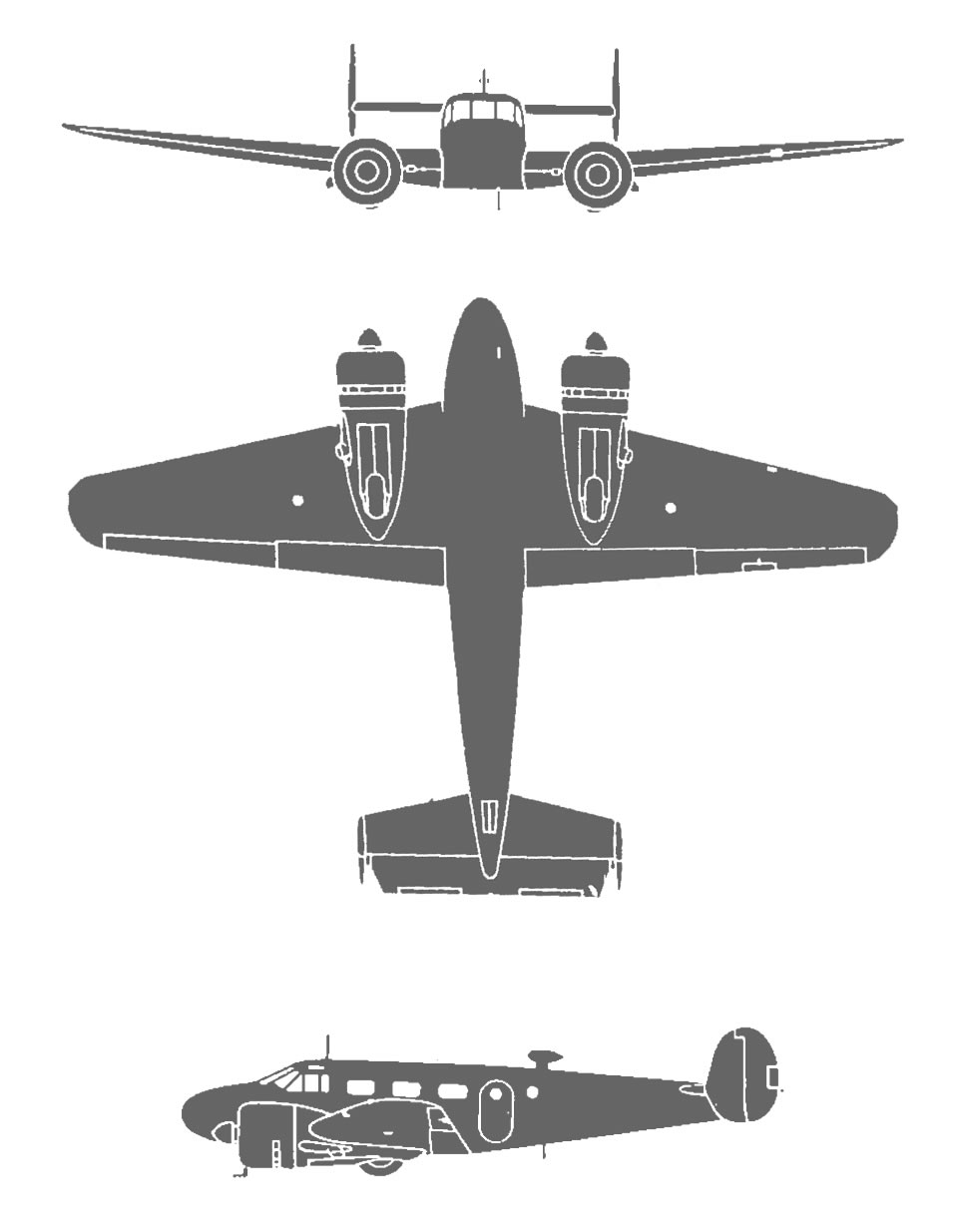
| C-45 Specs | |
|---|---|
| Role | Trainer / Utility |
| Manufacturer | Beech Aircraft |
| Introduced | 1937 |
| Produced | 1937–1970 |
| Power | 2 × Pratt & Whitney R-985-AN-1 "Wasp Junior" radial engines, 450 hp |
| Length | 34 ft 2 in |
| Height | 9 ft 8 in |
| Wingspan | 47 ft 8 in |
| Range | 1,200 mi |
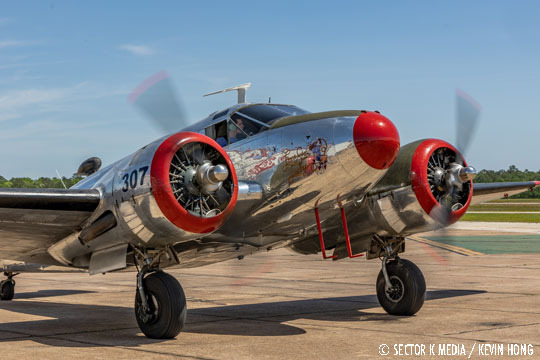
The C-45 was based on the Beech Aircraft Corporation’s Model 18 “Twin Beech”series. First flight for the original company design was recorded on January 15th, 1937 and the aircraft was introduced that same year. The US military adopted the Model 18 in many guises including the United States Army Air Forces (USAAF) which designated the type as the “C-45”. It went on to become a fixture within the inventories of the USAAF (later the USAF), the US Navy and the USMC and saw additional service overseas with British and Canadian forces through Lend-Lease. In all, some 9,000 Model 18 aircraft were built. Production spanned from 1937 to 1970. While the Model 18 served as the basis for the C-45, it was also the origin of the “Navigator” and “Kansan”. The C-45 went on to see considerable operational service in World War 2 and the Korean War in the light transport, VIP transport and mission liaison roles.
During and after World War II, more than 4,500 Beech 18s served with the U.S. military in a wide range of roles, including light transport, bombardier and navigator training, gunnery training, photo reconnaissance, and even as “mother ships” for target drones. Military variants included the U.S. Army Air Forces C-45 Expeditor, AT-7 Navigator, and AT-11 Kansan, as well as the U.S. Navy SNB series. During World War II, Beech 18 variants played a particularly important training role, helping prepare thousands of bombardiers and navigators for combat service.