
C-45 "Little Raider" Gulf Coast Wing
Description:
Base:
Conroe/North Houston Regional Airport, Conroe, TX
Website:
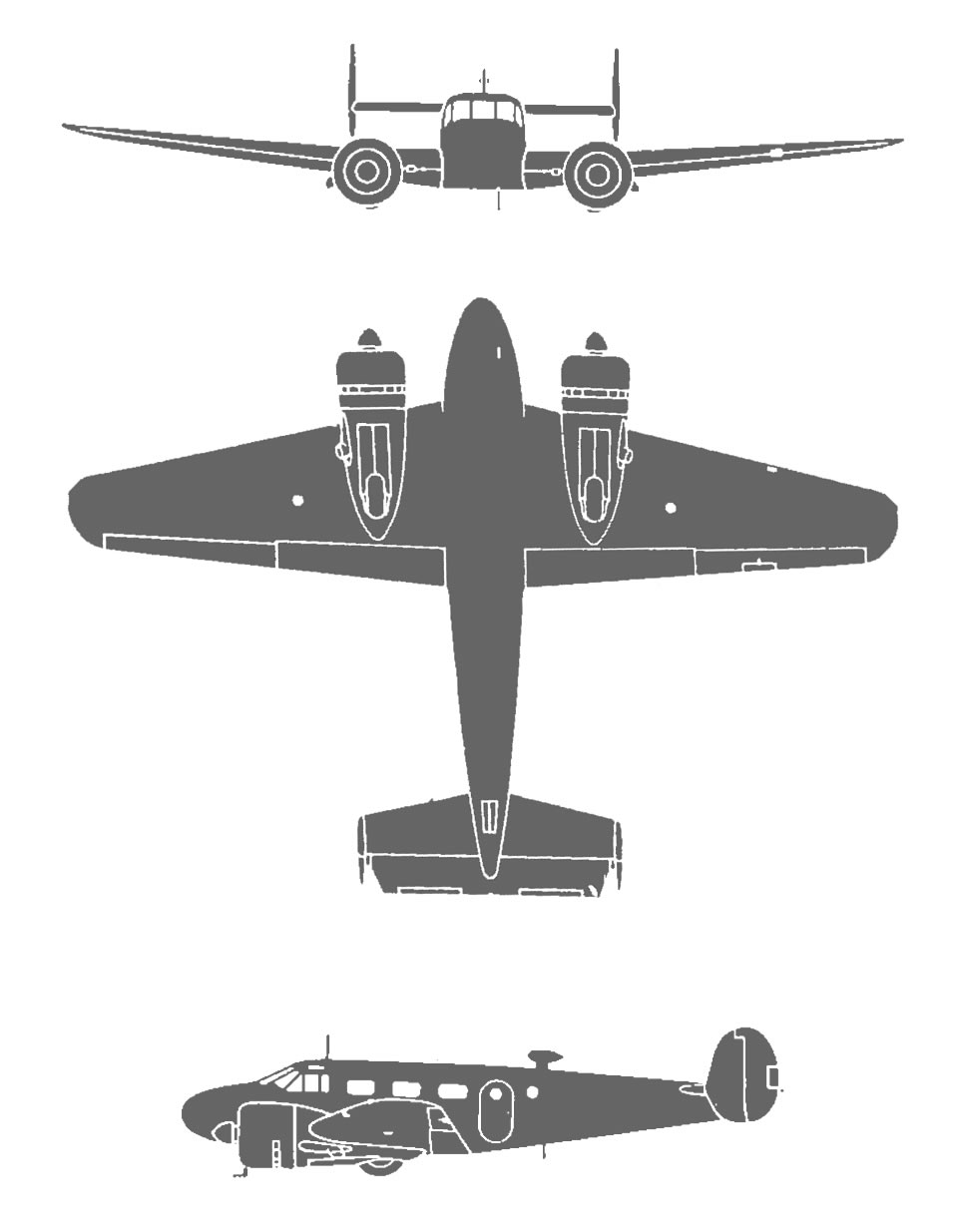
| C-45 Specs | |
|---|---|
| Role | Trainer / Utility |
| Manufacturer | Beech Aircraft |
| Introduced | 1937 |
| Produced | 1937–1970 |
| Power | 2 × Pratt & Whitney R-985-AN-1 "Wasp Junior" radial engines, 450 hp |
| Length | 34 ft 2 in |
| Height | 9 ft 8 in |
| Wingspan | 47 ft 8 in |
| Range | 1,200 mi |
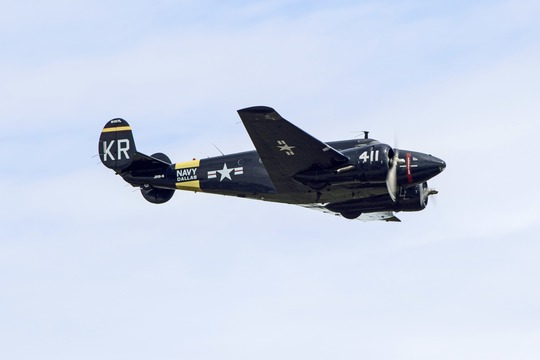
The 1947 Beechcraft model D18S arrived at Hooks Airport in Spring, Texas in August of 2016 from her former home in Ft. Worth. Routinely referred to as a “Twin Beech,” over 9,000 of these aircraft were produced at Beechcraft in Wichita Kansas, making it one of the world's most widely used light aircraft. 4,500 of them saw military service during and after WWII.
Commonly referred to with the military designation of C-45, these aircraft were used in the military as light transports, light bombers, and photo-reconnaissance planes. Large numbers of them also saw service as aircrew trainers for bombing, navigation and gunnery. In World War II, over 90% of USAAF bombardiers and navigators trained in these aircraft, so the aviators who flew in the nose of the Gulf Coast Wing’s B-17 Flying Fortress Texas Raiders almost certainly trained in a variant of the C-45 like this one. About 250 of the aircraft remain airworthy today.
Sporting tail number N197L, the twin-engine tail dragger is painted in Navy livery and marked as a USN JRB Navigator. She carries two Pratt & Whitney R-985 radial engines generating 450 horsepower each. The aircraft was manufactured in 1947 and is now configured inside to seat six, including pilot and co-pilot.
During and after World War II, more than 4,500 Beech 18s served with the U.S. military in a wide range of roles, including light transport, bombardier and navigator training, gunnery training, photo reconnaissance, and even as “mother ships” for target drones. Military variants included the U.S. Army Air Forces C-45 Expeditor, AT-7 Navigator, and AT-11 Kansan, as well as the U.S. Navy SNB series. During World War II, Beech 18 variants played a particularly important training role, helping prepare thousands of bombardiers and navigators for combat service.